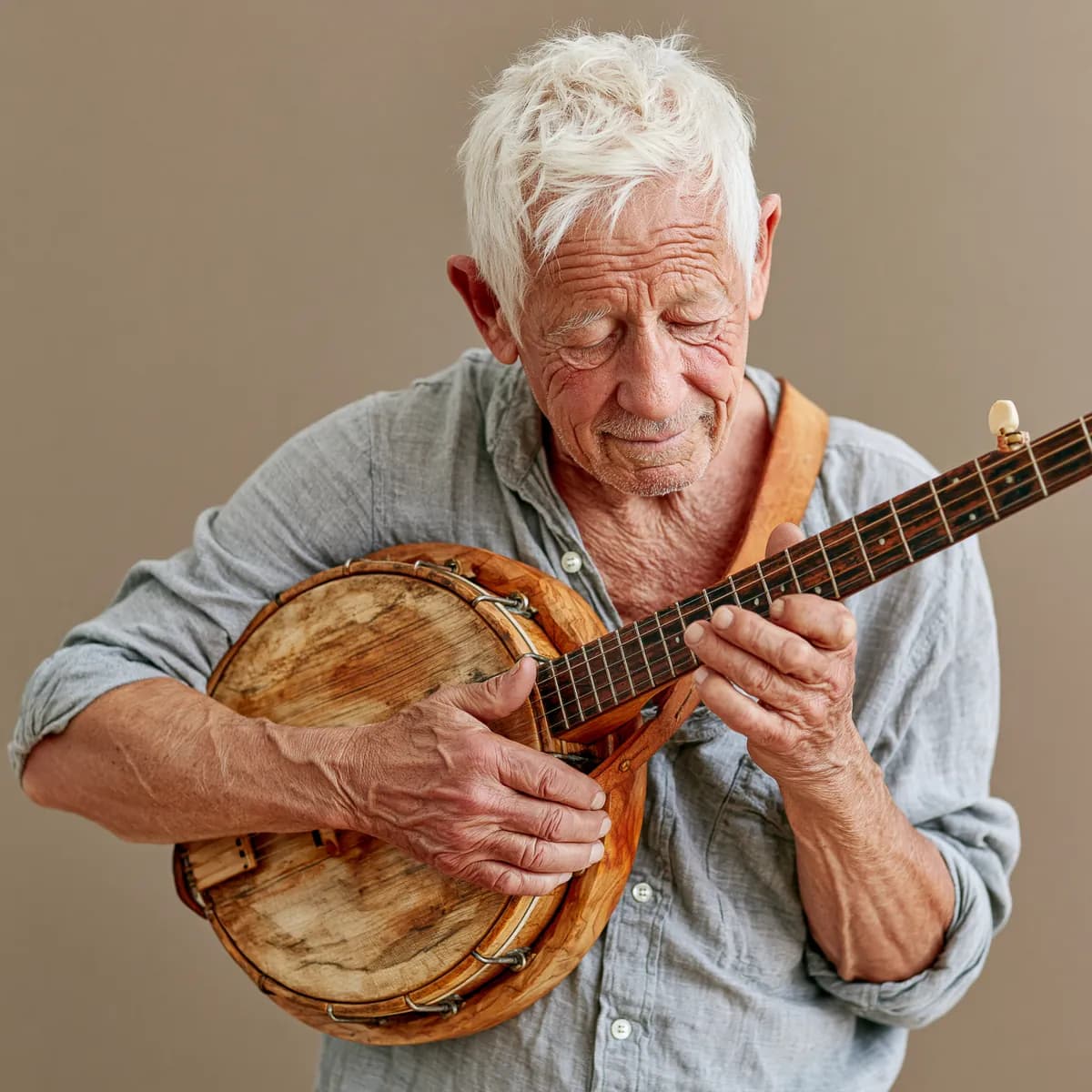

When daughters and grandkids ask us what country sub-genre fits a grandfather, the default answer they expect is classic country. Cash, Haggard, George Jones — the slow, weighty, mature voice they associate with elder men.
The default is wrong about half the time.
For a grandfather over 75, especially one whose family is gathering around to celebrate a long life, bluegrass usually works better. Here's why — and a real example from our catalog.
Why classic country misses for granddads
A classic country ballad about a grandfather has structural problems.
It's too slow. A 70-BPM ballad about an 80-year-old man drags. The pace makes the room sad in a way that doesn't fit the occasion — especially if it's a birthday, an anniversary celebration, or a family reunion where the man himself is in the room. Slow ballads tend to make grandfathers polite-uncomfortable rather than touched.
It's too solo. Classic country puts the singer at the center, which means the song becomes one voice talking about the grandfather. But most grandfather moments are family moments — multiple kids, grown grandkids, sometimes great-grandkids. The genre gives the song nowhere to put them.
It's too final. Slow country ballads tend to read as eulogies even when the man is alive. A grandfather sitting at the head of the table on his 80th birthday doesn't necessarily want to hear what sounds like the song his great-granddaughter will play at his funeral. He wants to be celebrated while he can hear it.
Bluegrass solves all three.
What bluegrass does that classic country can't
Five things bluegrass does that fit a grandfather song specifically.
It celebrates instead of mourning
A slower country ballad about a grandfather drifts into eulogy territory — even when he's still alive. Bluegrass does the opposite: it puts the grandfather at the center of a band, which is where most grandfathers want to be.
It makes room for harmony
Three-part harmony is a built-in bluegrass move. That means the chorus can include the grandkids — by name, by voice, or implied. Slow ballads don't have anywhere to put extra voices. Bluegrass does.
It loves specifics about places and tools
Bluegrass is a genre of inventories — towns, instruments, rivers, mountains, trucks, barns, kitchen tables. That instinct fits grandfathers perfectly. Most grandfathers live inside the inventory of a long life.
It ages well
A glossy ballad sounds dated within a decade. A bluegrass arrangement still sounds right in 30 years. The grandkids will play this song to their kids.
It doesn't ask the listener to cry
Slow ballads telegraph the feeling. Bluegrass leaves room for the listener to bring their own. That's why grandfathers don't deflect bluegrass songs the way they deflect direct sentimental ballads.
You can verify this in any working bluegrass standard — the genre's love letters to fathers and grandfathers tend to outlive the slow-country versions of the same songs by decades.
A real grandfather bluegrass song
Last year we wrote a song called "For Grandpa · 80th · Bluegrass" for a granddaughter named Emma. The brief was four sentences:
"From his granddaughter, with the whole family on the chorus. Eighty years, four states, a banjo he built himself in 1962. A bluegrass song about the man and the instrument that came with him."
Four facts to work with:
- He's turning 80
- He's lived in four different states across a long life
- He built his own banjo in 1962
- The song is from the granddaughter, with the whole family on the chorus
The arrangement was standard bluegrass — banjo, mandolin, fiddle, acoustic guitar, upright bass — with three-part harmony on the choruses (which we tracked as "female lead with family harmonies" in the brief). Emma told us afterward that her grandfather sat with the song for ten minutes after the first listen, then asked her to play it again. Then he asked her where the banjo verse came from, because he'd never told her about building the 1962 instrument — his daughter had.
That's the move. The song knew something the granddaughter didn't realize was knowable.
You can hear the full song on our Country page — it's the third song in the Birthdays group.
What to put in the brief
The strongest bluegrass grandfather songs share six details. Five is the minimum.
His full name and what he goes by
First name, what the grandkids call him (Pop, Granddad, Papa, the family Spanish, the family Yiddish, the family Cantonese). The chorus often uses the family name.
An instrument or trade
If he played an instrument — guitar, banjo, fiddle, harmonica, even the church organ — tell us. The arrangement can feature it. If he was a builder, mechanic, farmer, postal carrier, miner, or fisherman — tell us. Bluegrass is a working-hands genre.
Two places that matter
The town he was born in. The town where he raised the family. The county he's been buried in for 40 years if he's gone. Two place names land in bluegrass much better than abstract 'home.'
One specific story from your childhood
A specific Saturday with him. The fishing trip. The drive to the store. The afternoon in his workshop. One concrete story is what the song's middle verse uses.
How many grandkids and any names that should be sung
If five grandkids will be at the birthday party, tell us. The chorus can name some, all, or imply 'all of us.' Three-part harmony lets the song feel like the whole family is on it.
Whether he's still around
Living grandfathers and memorial grandfather songs use slightly different verb tenses and emphases. Bluegrass works for both — but tell us which.
Example brief
“For Granddad's 85th birthday in July. Name: Tom (Pop to all the grandkids). Born in West Virginia, moved the family to Ohio in 1968 for work, retired back to Charleston in 2002. Worked the rail yards for 41 years. Played harmonica every weekend on the porch. Five grandkids (Sarah 28, Mike 24, Jess 20, Emma 17, Caleb 12). Style: bluegrass, female lead vocal with full family harmonies on the chorus, harmonica solo in the bridge. Living. Mood: celebrate the long life, not foreshadow the end of it.”
When to use bluegrass and when not to
Bluegrass isn't always the answer. A few cases where classic country, country folk, or outlaw country beats bluegrass:
Grandfathers under 70. Bluegrass tilts elder. Younger grandfathers (60s) often fit modern country or country folk better — the sub-genres they actually listened to in their own thirties.
Memorial songs for grandfathers who are gone. Bluegrass can work, but it's faster than most memorial songs need to be. Country folk (acoustic, slower, more intimate) tends to land harder for funerals and memorial events.
Grandfathers with no Southern or rural connection. If he's a Manhattan grandfather who listened to jazz and read the Sunday Times, neither bluegrass nor classic country will fit. Try jazz standard or acoustic ballad.
Grandfathers who actually played country music. Sometimes a grandfather was the local country guitarist or fiddler. In that case, mirror the genre he played — not the genre that fits his demographic. Specifically tell us in the brief: "he played in a honky-tonk band in the 80s."
For the other 80% of cases — grandfathers over 75, multiple grandkids, family gathering, alive or recently passed, with any kind of working-hands or rural background — bluegrass is the move.
Get a free grandfather song
You give us his name, his trade, two places, one childhood story, the grandkid count, and whether he's still around. We write the lyrics, record the song with full bluegrass arrangement, and email the MP3 in about 30 minutes.
Right now it's free. 10 slots open every day at 10:00 AM EST. The kind of song that gets played at the family reunion three years from now.
Make Granddad's birthday the bluegrass one
Personalized bluegrass song · Family harmonies · MP3 in ~30 minutes
Get Granddad's free song10 free slots daily · Resets at midnight EST
Questions about bluegrass grandfather songs
More birthday song ideas